


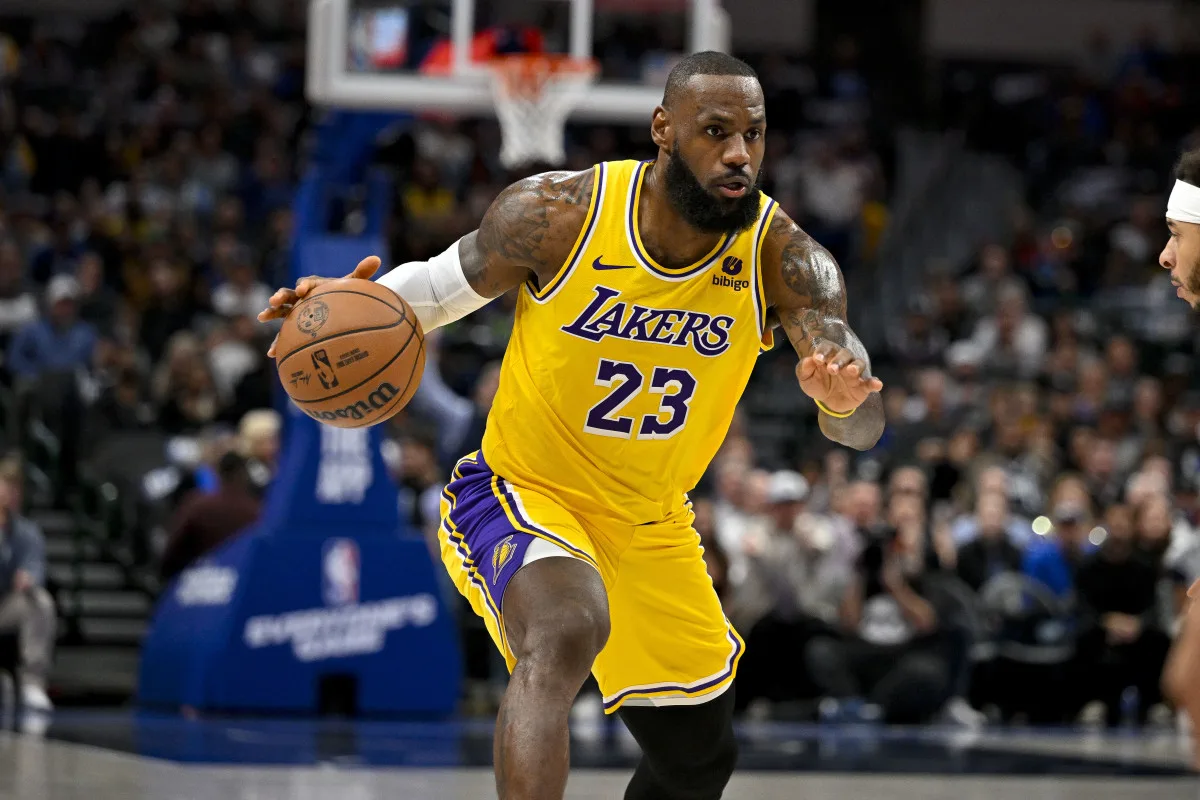
Nearly two decades on from his first crack at Mission Impossible, LeBron James faces a herculean task once again. 1-0 down against the heavily favored defending champion Oklahoma City Thunder in the Western Conference semifinals, the now 41-year-old GOAT has to somehow rally his Los Angeles Lakers to climb a seemingly insurmountable mountain. And he must do so, once again, without injured partner-in-crime Luka Doncic.
LeBron dropped 27 on OKC in Game 1, the most of anybody. It still wasn’t enough. It wasn’t even close to being enough. His Lakers were still beaten 108-90 on enemy territory, and online betting sites made his side even bigger underdogs to progress to the conference finals than they already were. The latest NBA betting at Bovada odds make LA a mighty +1200 underdog to progress, as well as +3000 to win it all. If they are to do so, it will be LeGOAT that somehow carries them all the way.
But here’s the thing. A fortnight ago, the arithmetic said Houston would get the better of them, too. That’s the thing nobody can quite file away cleanly.
The Lakers went into Round One as a team that the bracket had already processed and discarded. Then LeBron dragged them through anyway — vintage, relentless, defying every biological contract an athlete signs with time. Now he stares down the deepest roster in basketball, down 18 after Game 1, without his co-star, at an age when most men are coaching youth leagues or doing television. How far can one man truly take a team? History doesn’t answer that question cleanly. But it offers two reference points — and none of them make what he’s attempting look remotely comfortable.
LeBron James – 2007
19 years ago, LeBron James found himself in this exact position. Sasha Pavlovic was his second-in-command at Cleveland in the Eastern Conference Finals. Take a moment with that. Sasha Pavlovic — a 23-year-old Serbian swingman who averaged 7.2 points during the regular season — as a rotation cornerstone in the conference’s final four. That was the Cavs’ reality in 2007.
Daniel Gibson. Donyell Marshall. Drew Gooden, who would contribute exactly one free throw at the most important juncture of the entire postseason. These were the men surrounding a 22-year-old from Akron who had decided, somewhere between teenage prodigy and playoff warrior, that none of it mattered — he’d simply carry all of it himself.
What happened with six minutes left in Game 5, Palace of Auburn Hills, May 31, 2007, was the hot streak to end all hot streaks. A voluntary, conscious assumption of total responsibility — the kind that breaks most players when they attempt it — executed with a ferocity that made every Detroit defender look temporarily confused about which sport they were playing. LeBron scored 29 of Cleveland’s final 30 points. Twenty-five consecutively. All nine in the first overtime. All nine in the second. Forty-eight points total; 109-107 in double overtime; the Cavaliers alive, series closed in six, first Finals appearance in franchise history. Drew Gooden’s one free throw remains one of the great supporting-cast footnotes in playoff history.
Then San Antonio arrived in the Finals. Tim Duncan, Tony Parker, Manu Ginóbili — a dynasty that had won three championships in eight years and had seen everything a young superstar could manufacture. They swept Cleveland in four, unhurried, professional, almost clinical in their efficiency. LeBron averaged 22 points but shot 35.6% from the field; nobody beside him capable of punishing the Spurs’ defensive rotations.
The sweep didn’t break him. It educated him. There’s a version of the story where the humbling in 2007 is the making of everything that came after — nineteen more postseasons, four championships, a basketball life so long it now finds him, at 41, in a visiting locker room, icing his knees after an 18-point loss to OKC. That 22-year-old and this 41-year-old are the same man, with the elder statesman looking to somehow accomplish the same impossible feat.
Dirk Nowitzki – 2011
Nobody gave Dallas a credible chance in 2011. LeBron had made “The Decision,” choosing to form the big three alongside Dwayne Wade and Chris Bosh in Miami, and the basketball world had already engraved the Heat’s name onto the Larry O’Brien. Standing between them and their impending coronation: the Dallas Mavericks, built around one European with a shooting touch so pure it felt architectural, surrounded by veterans — 38-year-old Jason Kidd, Jason Terry off the bench, Tyson Chandler as defensive anchor, Shawn Marion as stopper. Not a superteam. Not even close.
Dirk Nowitzki had already somehow swept Kobe Bryant and the three-peat seeking Lakers and dismantled an OKC team containing Kevin Durant, James Harden, and Russell Westbrook. He headed into the finals against the “Big Three” with a torn tendon in his right index finger. His shooting hand. The one he’d spent thirty years developing into one of the most lethal individual instruments the sport had ever seen.
He wore a splint. He still canned one-legged fadeaways over LeBron James in fourth quarters while the entire basketball world waited for Dallas to crack. In Game 4, with the Mavs trailing 2-1 and Miami pushing for the kill, Dirk produced 21 points and 11 rebounds. LeBron scored just eight. The lowest single-game total he’d managed since 2007. As the final minutes of Game 6 bled out, as the arithmetic shifted irrevocably toward Dallas, Dirk slipped into a bathroom stall alone. He wept. Before the buzzer. Overcome before it was mathematically official, because some part of him already knew — the splint, the fadeaways, the six games of refusing to let Miami have it — had been enough. He emerged as champion. First German-born player to win Finals MVP. The man who brought down the superteam.