


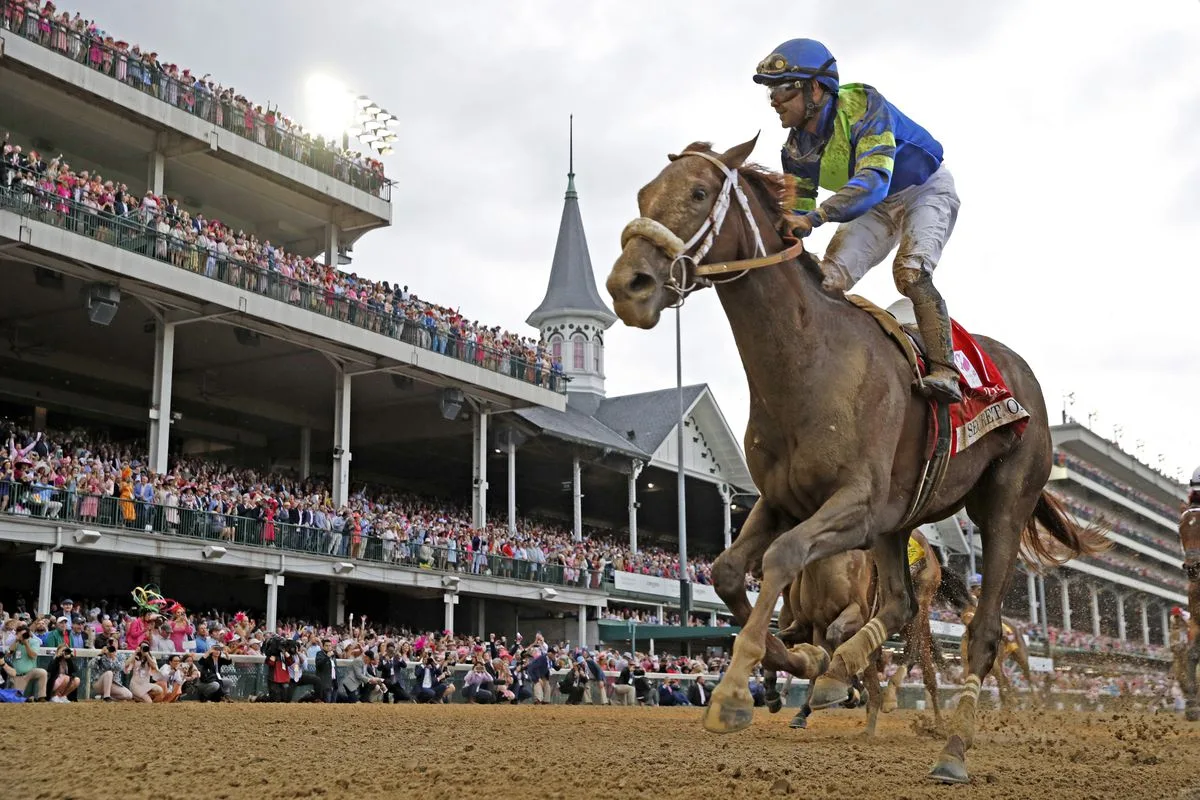
Racegoers talk about Cheltenham as if it were one track, but Prestbury Park is several layouts sharing the same stretch of Gloucestershire turf. Anyone who follows British horse racing will have heard commentators refer to the Old Course or the New Course, often without explaining what separates them. The answer is three courses in use today, plus a fourth that quietly disappeared in the 1990s.
The Old Course
The Old Course stages the Showcase in October, the November Meeting and the first two days of the Festival in March. It is the sharper of the two main tracks, with a shorter home straight that suits horses with a quick turn of foot.
That is why the Festival’s speed championships are run on it. The Champion Hurdle, over two miles and 110 yards on the Tuesday, and the Queen Mother Champion Chase, over two miles on the Wednesday, are both Old Course races.
The New Course
The two main courses sit alongside each other, and both are left-handed and undulating. The New Course takes over for the Christmas Meeting, New Year’s Day, Festival Trials Day, the April Meeting and the last two days of the Festival.
It is the tougher test of stamina. An extra loop and a longer run up the home straight make the difference, and chasers also face a tricky downhill fence and a longer run-in than on the Old Course.
The Stayers’ Hurdle and the Ryanair Chase are run on it on the Thursday. The Gold Cup closes the Festival on the Friday over three miles, two furlongs and 110 yards, which is just over two full circuits.
The famous hill
Both courses finish up the same climb. The rise is about 10 metres over roughly three furlongs, and the Racing Post points out that it is not the stiffest finish in Britain or Ireland, with Leopardstown’s steeper.
The hurdles tracks share a quirk too. On both courses there are only two flights to jump in the final three-quarters of a mile, so the closing stages of a hurdle race are mostly about galloping rather than jumping.
The Cross Country course
The third track is laid out inside the main racecourse. Cross-country racing arrived at Cheltenham in 1995, the same year Sunday racing began there, and Timeform describes it as British racing’s only cross-country course.
Instead of standard fences, runners tackle banks and ditches, with obstacles that borrow heavily from Irish banks racing and three-day eventing. The newest obstacle, the cheese wedges, has been in use since November 2009.
The course stages one race each at the November Meeting, the December Meeting and the Festival, where the Glenfarclas Cross Country Chase is run over three miles and seven furlongs on day two. Tiger Roll, the dual Grand National winner, was its outstanding performer and won the Festival race in 2019.
It has also caught riders out. In 2002, three jockeys received 10-day bans for jumping the wrong side of a fence. Two years later, Registana was disqualified after being ridden up the wrong straight.
The Park Course
For six seasons, Cheltenham effectively had a fourth track. Between 1990 and 1995, its early-season meetings used the Park Course instead of the Old Course, because of concerns about watering so much of the main track.
It was a short-lived fix. From 1996, the October fixture returned to the Old Course, and the Park Course has not been used since.